Slideshow

Get the Flash Player to see the slideshow.

Space, the final frontier. Add a little space to your solo’s!

Space, the final frontier. Soloing concepts

Most young soloists and even experienced players play too many notes. My suggestion is to approach drumming as a musical composition. In music, soloing is more about what you don’t play, then what you do play. I am talking about space.
Phrasing and space. Space and phrasing. As Lao Tsu the legendary philosopher once said, ” it is not the walls that are important but the space with in it”.

art of soloing on hand drums

art of soloing on hand drums

I have noticed that many players work there way to a feel by playing many notes. They are pawing there way in. Playing pacer notes and sometimes loudly. My recommendation is to learn solo phrases.

You can learn and hear these phrases on any djembe album, tune or from a teacher and some people even have these posted on line such as on the WAP pages. I urge you to learn as many as possible from a good teacher. For conga solos there are DVD’s or listen to the classic “quinto lock” over and over on any Munequitos tune! For Timbales Changuito is my favorite to listen to for chops.

Soloist Jesse Seymour loves to use space in his phrases!

Soloist Jesse Seymour loves to use space in his phrases!

Actualy try and speak these phrases when you practice soloing. My 2nd drum teacher Nuru always said, if you can say it you can play it. This goes for patterns and soloing as well. Force yourself to stop or rest in between phrases. It is one of the hardest things to do! To simply not play! At least at first anyway. Have a watch or clock and see how comfortable or uncomfortable it is to not play in between phrases.

It constanly amazes me how hard it is for people (myself included) to use space as an equalizer, but if you listen to a recording of yourself after wards I am sure you will agree with me 100%

In Guinea West Africa I noticed there is not a lot of space used in the soloing. Why is this? There are always so many soloists at any given time in any playing situation that if one person leaves any space what so ever, another soloist will “drop in” on him.

Michael P soloing on djembe

Michael P soloing on djembe

“Dropping in” is a term I coined from surfers who cut in on other surfers waves and take the ride away from them. Although this “dropping in” has always to this day felt rude and akward to my western sensibilities, it is definitely the way of the djembe drum in Guinea!

Once you learn traditional phrases you will see that they are actual little patterns tied together and repeats in sequences. Once you have learned that structure, you can even make up your own. But again, you have to learn the structure first. If you do not build a strong foundation the house caves in!

Too me, soloing is like boxing. A good boxer will jab his way into his opponent and then set up for a combination of punches. there is a lead in and a follow up, then a “finish”. Map out your solos. Have in mind a start buildup and a finish, and always save a little juice for the end!

Make sure you are playing to the pulse, or have the pulse in reference so that there is reference to the pulse at times. I know some great players that are so great no one understands what they are playing when they are soloing. This is because they go so far out there that it is hard to follow because they have the pulse inside their head, but they do not reference it at all to give the audiencean angkor or reference to where the neat is.

If you hear an up beat long enough with out reference to the down beat pulse you will get pulled into the up beat and start hearing that as the down beat.

It is fine for them, but to me the concept is to connect with the audience or whoever is listening.

Congas: basic hand position and playing techniques

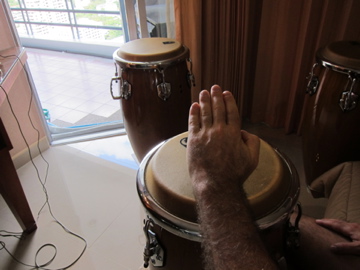
“With out strong framework the house will collapse’. In this ‘follow along” video/ conga lesson we will begin to explore how to position your hands and also how to make basic sounds on the conga drum. This is part one

congas to djembe/djembe to congas

When an established conga player transitions to learn to play djembe he or she has certain advantages and disadvantages. When you play congas, there is much emphasis on pushing in to the drum to make tone. On a goat skin djembe, do to the thin tight skin, you must pull the sound out.

work on pulling and keeping your hands in near the rim

work on pulling and keeping your hands in near the rim

Despite this energetic difference, the technique for making tone is nearly the same, you just do not leave your hand in the drum as long, you alllow it bounce making one fluid hit and return motion, vs two seperate motions. I call it follow through. When you hit a baseball with a baseball bat you do not stop when you hit the drum. Your motion continues forward
making contact right side before final motion to pull in to rim

left hand and right hand slap set up for final

left hand and right hand slap set up for final

On djembe drum it is the same. You can not go through the drum so you allow your slap to spring back. This is something that needs to be practiced over and over. The “spring back”.
By allowing your slaps and tones to spring back after you hit the drum, you thereby reduce your output of energy. MY first drum teacher George Terzis in Boston puts it simply, “minimum imput, maximum output”.

One difficult thing for a conga player to loose, (myself included) is the cup motion of the conga closed slap. Many modern conga players actualy use an open slap similar to djembe these days especiay for the modern Afro Cuban techniques.

Many Guinea djembe experts have a slap that is extremely close to the rim and uses very little of the hand where as the Cuban style traditionaly uses much of the hand. This is also hard for a conga player to put so little hand on the drum.

rt hand pre pull back to rim

rt hand pre pull back to rim


If anyone has seen Mohamed Diaby play he is an expert at the close to skin slap and made me a true believer of it’s power and sound output as well.

So for all the conga players out there who want to also play djembe, really work on pulling your hands back closer to the rim for slap, tone and bass!

LP Galaxy Giovanni Series Congas Test Drive/demo by Michael Pluznick

Michael Pluzick takes the LP Galaxy Giovanni Series Congas for a test drive and demo. Watch here for full review coming soon!


List Price: $924.00 USD
New From: $419.99 In Stock

Leave your ego at the door please..

Don’t let your ego in the way of making you a great drummer. A great freind and teacher  used to tell us before class. “Leave your ego at the door”. When we come together to drum, to learn or to play together it is important we come with respect for each other no matter what level of playing we are at.

Everyone can drum and everyone has their own unique beat or inner rhythm. If we did not, we would not be alive. The heart is our pulse. All throughout my life I have always tapped, and still after so many years always notice people tapping. It is a universal thing everyone does. We all can relate to drumming. This is for sure!

Wide world of drumming

Master drummer "Eddie" from Liberia in Bangkok

Sometimes in the study of traditional drumming we try so hard to emulate our teachers and the styles we are studying that we forget the validity of our own natural rhythms and ideas. Other times we feel so much, we have so much enthusiasm and we sound so good to ourselves we believe we are already there. In some ways we are, but..with out technique, how to hit the drum how to make sounds how to annunciate properly, we are missing out on a much greater experience. Not only for ourselves but for anyone lse that happens to be listening as well.

When I listen to my tapes from my jazz band at RISD in 1975 I made painfully aware of my thunder drumming past. People told me I should take classes but I was sure I already “had it”. I was so in tune with the records I was playing and I was so happy to jam all day. Basicaly my ego was huge. It felt so great to play, I thought I was great! My ego just could not believe that I was not already a master in one year! That is how excited I was about playing. The creative force is powerful in us. I did not want to study a form, have yet another teacher tell me what to do, tell I was wrong. Or have some one cramp my style.

Raymond Rausch play the dununs

Raymond Rausch play the dununs

Drumming for me in the beginning was about freedom of expression. Playing from the heart and letting it all rip. But I had an experience that changed my life forever. It happened one night when the RISD jazz band was playing at a local club. The saxophonist invited M’Butu, local conga player to sit in with us. He came with four drums and set them up in the front. Annoyingly he played through each brake even when the band stopped. He was trying to make a point.

When I got up the courage to confront him after the gig I asked him, “why did you do that”? He told me something I will never forget. And I will pass it on to you. “If you do not listen to people who are better then you, you will never learn or improve”. I had an epiphany, and this is when I decided to change from being an artist to being a musician. I moved to Boston in 1976 to find a teacher and begin my studies as a professional player. Since then despite becoming a teacher, a recording artist and many other things, I have never given up being a student. I always take classes even from group members or people that may not know as much as me, but know something I do not know.

Listening to others even beginners is valid and important. You can learn from anyone at any time regardless of level or experience and really for me drumming is all about learning. Study from a valid teacher and balance it out with your own feelings and beats as well.

Barabajaba performance

MIchael P on djembe, Jesse on Dun's, Tojo on Shekere @ Barabajaba performance

Now that I have been playing over 30 years I see that you need to learn a form before you can drop the form. Many of us in the west want to drop the form before we ever learn it though. However, a strong foundation in basic concepts of drumming, in time and technique is incredibly important. Technique, or how you hit the drum and make sound is an ever expanding and never ending search. If we can put our egos aside and support each other we can have much more harmony in our drumming and in our communities as well.

Listening to learn

Many drummers new to the art of djembe music think that they must play and participate in a drum circle, jam or dance class as a way to learn to drum. Most experienced players will tell you something different. By going to a djembe session or African dance class and sitting on the side watching you can learn much by listening, observing and even taking musical notes! By sitting outside of the music going on you can can absorb many things that you will not when you are on the inside playing a part. Often as a new drummer , (or even expert) you have to concentrate on playing your part correctly and repetitively. Therefore,  you do not have the chance to really listen to each individual part in depth and check out the relationship to each other. However, by sitting on the sidelines in a relaxed manner you can really see  and check out all the relationships of parts within the drum arrangement. Furthermore, you can examine how more experienced players play, what techniques they use, their postures and composure. So please add  watching and observing to your learning experience!